.png)
The BC Wolf Cull: Why Culling Isn’t Conservation
- Renée Nicole
- Jan 12
- 4 min read
Updated: Jan 13
I have always believed that to be 'In the Wild' is to be in the presence of a perfect, albeit fragile, balance. But lately, that balance in British Columbia feels more like a facade. Like many of you, I grew up believing that 'conservation' meant protection. I thought it meant being a steward of the land.
That is why I started Capturing In the Wild. I wanted to document the raw, unfiltered beauty of our ecosystems. But you cannot point a camera at the BC wilderness today without seeing the scars of industrial overreach and the heartbreaking reality of the BC wolf cull. For me, 'Culling Isn't Conservation' isn't just a slogan, it's a plea for honesty in how we treat the wild.

Fact vs. Fiction: Dismantling the Cull
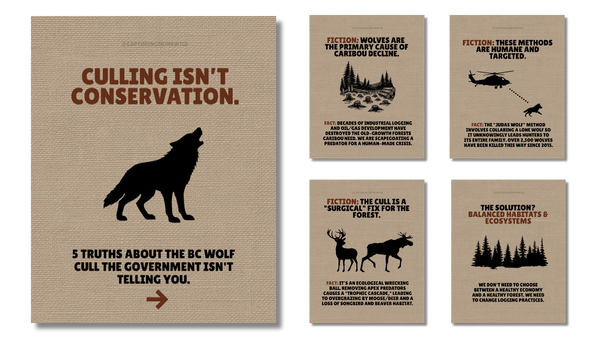
Fiction: Wolves are the primary reason caribou populations are collapsing.
Fact: Wolves and caribou have coexisted for thousands of years. The real "predator" is habitat fragmentation. Industrial logging, mining, and oil exploration have shredded the old-growth forests caribou need to survive. These activities create "early seral" habitats—clearings filled with shrubs that attract moose and deer.
As moose and deer populations grow, wolf populations naturally follow. Humans have essentially "invited" wolves into caribou territory by building the very roads and seismic lines they use to hunt.
Fiction: The BC wolf cull is a "scientific" way to restore ecological balance.
Fact: The cull is a "band-aid" that ignores the root cause. While killing wolves might lead to a temporary spike in caribou calf survival, it does nothing to fix the broken landscape. In fact, culling creates a trophic cascade. Without wolves to regulate their movement, moose and deer overgraze the vegetation, destroying the nesting grounds of songbirds and the food sources of other wildlife. We are "fixing" one imbalance by creating five more.
Fiction: Culling is a last resort.
Fact: While the government claims culling is necessary because "time is running out," they continue to approve new logging permits in critical caribou habitat. True conservation would prioritize the immediate cessation of industrial activity in sensitive areas. Instead, the wolf is used as a scapegoat so that industry can continue "business as usual."
Fiction: The methods used are humane and targeted.
Fact: The BC wolf cull relies heavily on the "Judas Wolf" method. A wolf is captured, fitted with a GPS collar, and released. This social animal then returns to its family, unwittingly leading a helicopter crew to the entire pack's location for slaughter. This process is repeated year after year, traumatizing the surviving individuals and destroying the complex social structures that define wolf ecology.
The Domino Effect: A Forest Out of Sync
When I look through my lens at a clear-cut or a landscape fragmented by seismic lines, I don’t just see missing trees. I see the beginning of a terrifying domino effect. We are told that killing wolves is a "surgical" fix. But ecology isn't a math equation; it’s a web. When we remove the apex predator, the thread snaps:
The Overgrazing Crisis: Without wolves to keep them moving, moose and deer linger in one spot too long. They over-browse the willow and aspen, stripping away the habitat that songbirds and beavers rely on.
The Scavenger Void: I think about the ravens, eagles, and wolverines. In the winter, these species rely on the 'leftovers' from wolf kills. When we eliminate the wolves, we inadvertently starve the scavengers.
The Loss of the Wild Spirit: Beyond the biology, there is the ethical cost. Watching a social, intelligent species be used as a scapegoat for our own industrial greed changes how we relate to the wild. It replaces respect with management, and awe with interference.
The Broken Balance: A Forest Out of Sync
When we remove the wolf, we do not just lose a predator; we lose the "manager" of the forest. The imbalance we see today is not an act of nature because it is a human creation. For decades, our forestry management has prioritized high-volume clear-cutting. This practice has fundamentally re-engineered the wild to the detriment of caribou.
By focusing on lethal control, we are ignoring the most uncomfortable truth. To save the caribou, we do not need fewer wolves. We need a complete modernization of our forestry practices. We must move away from industrial clear-cutting toward ecosystem-based management that prioritizes the health of the entire forest web over short-term timber volume.

What We Must Do Now
I didn't design this campaign to just share sad statistics. I designed it because I believe we can do better. We cannot keep "protecting" the wild by killing it.
If we want to save the caribou, we have to stop the logging in their last remaining sanctuaries. We have to demand that our government stops using helicopters and Judas wolves to cover up for industrial permits. We must shift from a culture of "management" to a culture of true stewardship.
Here is how you can stand with me:
Share the Truth: Use the "Culling Isn’t Conservation" graphics to start a conversation. Word of mouth is the only way to break through the government's "management" narrative. Download here.
Demand Habitat, Not Bullets: Write to the BC Minister of Water, Land and Resource Stewardship, Honourable Randene Neill. Tell her that taxpayer money should be spent on restoring habitat—not on aerial gunning. Copy and paste the below into an email and add your details at the bottom.
Advocate for Real Solutions: Push for proven, non-lethal alternatives like maternal penning (protecting mothers and calves during calving season) and linear restoration (replanting old logging roads to slow down predators naturally).

The wild doesn't need us to "manage" it into submission. It needs us to give it the space to be wild again.
The wild doesn't need us to 'manage' it into submission. It needs us to give it the space to be wild again.
Resources for Deeper Learning
Pacific Wild: Extensive reports on Freedom of Information (FOI) findings regarding the inhumanity of the cull.
The Fur-Bearers: Data-driven blogs on the annual numbers and costs of predator reduction.
Raincoast Conservation Foundation: Scientific papers linking caribou decline to industrial subsidies.
Comments