.png)
High Peaks & Pikas
- Renée Nicole
- Jan 2
- 8 min read
Updated: Jan 8
Featured Artist: Wildlife Conservation Photographer Deirdre Denali Rosenberg

Deirdre Denali Rosenberg is a wildlife conservation photographer and storyteller based in the San Juan Mountains of Colorado. Her work centers on high-elevation ecosystems and the resilient species that call them home- especially the American pika -while also exploring the rich biodiversity of the Sonoran Desert and the wider Southwest. Through long days in the alpine, remote fieldwork, and time spent in desert landscapes, Deirdre uses photography to build empathy for often-overlooked species and to advocate for the protection of public lands. Her images blend scientific curiosity with a sense of wonder, inviting viewers to slow down, look closer, and fall in love with the quiet lives unfolding across wild places.
Tell us about the landscape you live in and what makes it so special.
I live in a very rural part of Colorado’s San Juan Mountains. My little home is situated in the foothills, above the San Juan River. The east of my property is a ponderosa pine forest, while the west side transitions to high desert scrub; juniper, scrub oak, yucca and the critters to match! I believe that these two very distinct landscapes are a big part of what has held my heart here for so long. It’s impossible to tire of the views, scents, sounds… all of that… when it’s so varied. In pretty short order, I can find myself above 14,000-feet from my home as well, which is another thing that makes where I live very special.It’s hard for me to rein it in when it comes to talking about where I live, so I’m going to take a moment to elaborate a bit, because it really is so special here.Where I live is one of the most rugged regions of the lower 48 here in the States. A lot of places make claims like this- here we don’t claim it. It’s just a fact. There aren’t many people who call my county and our surrounding counties home, but for those of us who do, we experience a life that is beyond intertwined with nature. This area is where the South San Juan Wilderness and Weminuche Wilderness connect. The former being the least explored wilderness areas in the West, the latter is Colorado’s biggest wilderness area. The San Juan Range has 14 peaks over 14,000 feet high, and over 314 peaks over 13,000 feet. Between these wilderness areas, the largest mule deer migration in the lower 48 takes place. These mountains truly are an epic place for wildlife due to how wild they are, how huge they are, and how few humans are out exploring them.
I could go on forever. I love where I live.

Is it fair to say your main subject focus is the American Pika? If so, why do you connect so strongly with them?
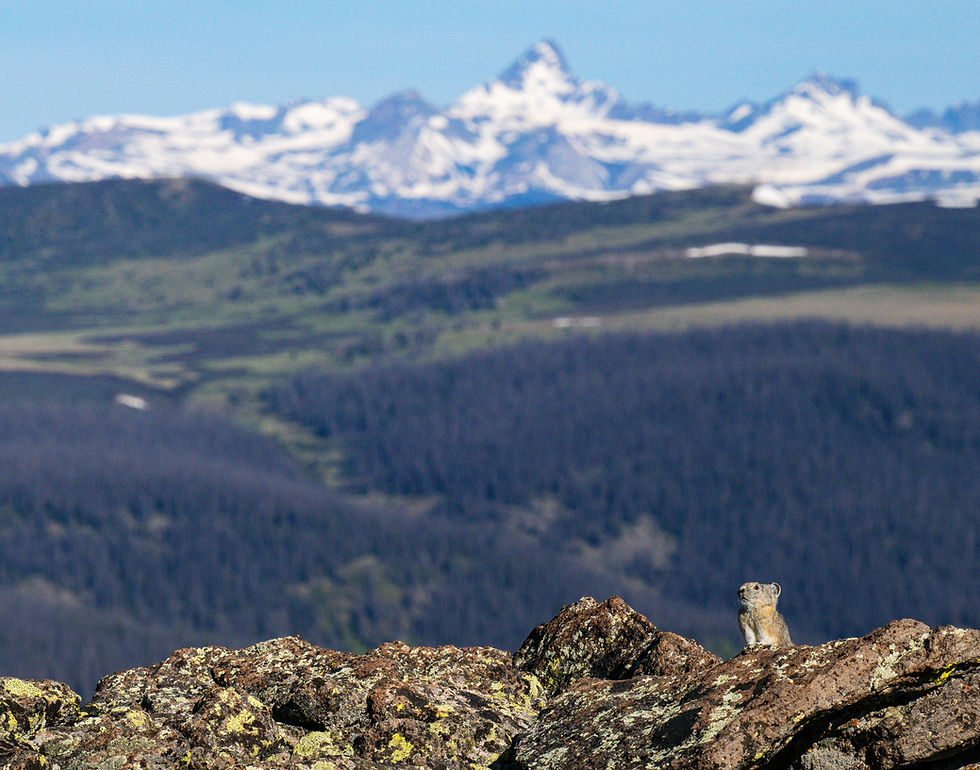
I definitely think it’s fair to say! When I began working with pikas, most folks hadn’t seemed to have ever heard of them. And there really wasn’t any representation of them anywhere. I had loved spending time with American pikas since I was barely old enough to walk, so I sort of made it my mission to be the voice for American pikas.
Pikas are in some of my very earliest memories, and I so enjoy just spending time with them in general. Before photography was my career, back when I could have adventures without my camera strapped to my chest, I was very heavily into mountaineering and climbing. This brought me into pika habitat a ton. So I have just always had a connection to the species. I think that’s what I’m trying to explain here, haha.
For me working with pikas is beyond rewarding, and it’s been cool to see them become much more well known, even becoming the subjects of citizen science campaigns! They are a phenomenal species to get folks interested in conservation.

At what age did you realize that you wanted to work in the field of conservation photography? Was there a moment or shift? And, when you were younger, what were your aspirations?
I always knew I wanted to be a nature or wildlife photographer. From the time I can remember. In my entire life I have always had and used cameras. From film to mirrorless; it’s been wild. Anyways, conservation didn’t become my field of choice until I was around 29 and really sorting out what I wanted my career trajectory to be before I hit 30! Not that I needed to achieve anything by then, but I am a woman who loves a plan. And as a photographer, it’s quite helpful to know the angles you’re working with subjects of course.
There was a very definite shift for me when it came to focusing on conservation photography. I was living in a different part of Colorado and was struggling to not be constantly frustrated with people enjoying nature, which is a problem! I was frustrated by people with cameras in Rocky Mountain National Park approaching, feeding and disrespecting wildlife. I was so disheartened seeing people harass bighorn sheep during the rut along the I-70 corridor. Obviously fed foxes, folks damaging alpine tundra. The list goes on. At a certain point all these things I had been seeing and being annoyed by added up to a sum that tipped me into a conservation photographer. I wanted to shine a light on some of these issues, and it all just kind of started growing from that point.
What does the definition of “conservation photographer” mean to you and for you
To me, a conservation photographer is a visual storyteller with a responsibility. It’s someone who uses photography not just to document places and wildlife, but to help people care about them. To make the unseen visible and the distant feel personal. It’s work rooted in curiosity, creativity, and deep respect for the natural world, with the hope that by telling these stories honestly, we can inspire protection, stewardship, and lasting change. It must be stated that “conservation” does not equate to “ethical”. To me, conservation photography is more than just a label. If the process isn't ethical, it doesn't count as conservation.
To me, conservation photography is more than just a label. If the process isn't ethical, it doesn't count as conservation.
For me, being a conservation photographer has meant hitting those marks above. But because I have an online presence, I have also felt it important to try to lead by example, so Conservation Photographer has also turned into Conservation Communicator in many ways. It makes my work a lot more impactful, I think. Gets people curious!
Women are underrepresented in this field and we face different challenges that men don’t. What is one thing you’d like to see change?
I am going to be extremely transparent here and say that due to how I create most of my work and what I do with it, I’ve not experienced much of this. So my response might be a little bit oddball here, but I would like to be able to talk more openly about what women deal with. Just more open communication without freaking men out. Maybe this is more of a social issue in general. But we all have unique life stories, and this has impacted my work in conservation photography a lot. I can use myself as an example. Years ago I experienced a missed miscarriage, where my body did not physically manage the miscarriage in the typical way. And living where I do, I was not granted the minor surgery to fix this problem. So instead of my loss being medically handled, I had to have my dead child in my body for three months until I was almost dead of sepsis and rushed to ER for an emergency surgery, followed by a very lengthy hospital stay. It isn’t common practice or socially acceptable in general to talk about loss and miscarriage like this. But I HAD TO WORK IN THE FIELD for three months carrying my dead child, while I was slowly dying, with a message from my doctor to not be further than a half hour drive to a hospital in case my body decided to just bleed out. I shot a story that launched my career during those three months. I was hours away from a hospital when I shot it. I would not be where I am if I had turned that story down. If I had been honest about my condition, the story would have gone to a male peer in the field.
Men do not have to deal with this kind of thing as they attempt to start a family. Or when they’re just out shooting. This is maybe an extreme example, but I hope the concept translates. I think many women who experience things like PCOS, endometriosis, severe periods and the like would feel a lot more confident in this field if actual communication was the norm.
As photographers, we are the record keepers.
Why do you think it’s so important in this day and age that photographers get out in the field and connect with animal subjects?
Not to be a bummer, but things are changing, ya know? Whether that’s development, natural disaster, or climate change overall. For photographers who love nature and wildlife and the beauty of our planet, it is certainly the time to shoot! We are capturing what is and our planet will not ever be the same as it is now. To me, this makes the work very important.
People in the future may not get to experience forests like we do now. They might only read about some species in a book of extinct animals. As photographers, we are the record keepers. Find what animals you are passionate about and spend time with them. Know them. Capture their stories. It’s such a special thing we’re able to do.

What or who inspires you to continue even when the weather is horrible or your motivation is lacking?
In my life I have seen so many of the places I have lived, loved and explored be destroyed or had future destruction on the table. I have borne witness to wild animals fleeing the only habitat available to them as it’s built up with buildings and roads. I have experienced what it means for a full ecosystem to be poisoned by a government so they can appease tourists who fear small animals in the wild. I have had my heart shattered by the harsh realities of the lives of wild animals trying to survive in a changing world.
Very few things matter more to me than ensuring some of these atrocities stop or never begin. That’s been my inspiration for everything as a photographer when it comes right down to it.
If you could give a new photographer who wants to make a difference in conservation, whether it’s wildlife or the wild, what would you share with them?
If you are really wanting to make a difference in conservation, dial in your ability to tell stories, and stay local as much as possible. It is much more simple to tell a story in a place where you don’t need to travel to. And as a resident, you are an expert of that place! You already have a voice. A local story is always a solid story.
And also… do whatever you possibly can to protect the beautiful parts of yourself that are curious, sensitive and passionate. This field is important, but our world can be very brutal. No matter what you focus on, there are going to be things about it that bum you out or make you question if you can do this. You can totally do this, but only if you set some boundaries for your mental health and sense of self.
You can find out more about Deirdre by visiting her website, Patreon and Instagram
Interested in being a featured Conservation Artist? Please send us an email...


Comments